Organizations face ongoing cyber threats, but many are unsure if their security testing improves their defenses. A common source of confusion is the difference between a vulnerability scan and a penetration test.
Although both are critical security techniques, they serve different purposes. Unfortunately, vulnerability scans are sometimes marketed as penetration tests, which can mislead organizations, increase costs, and give a false sense of security.
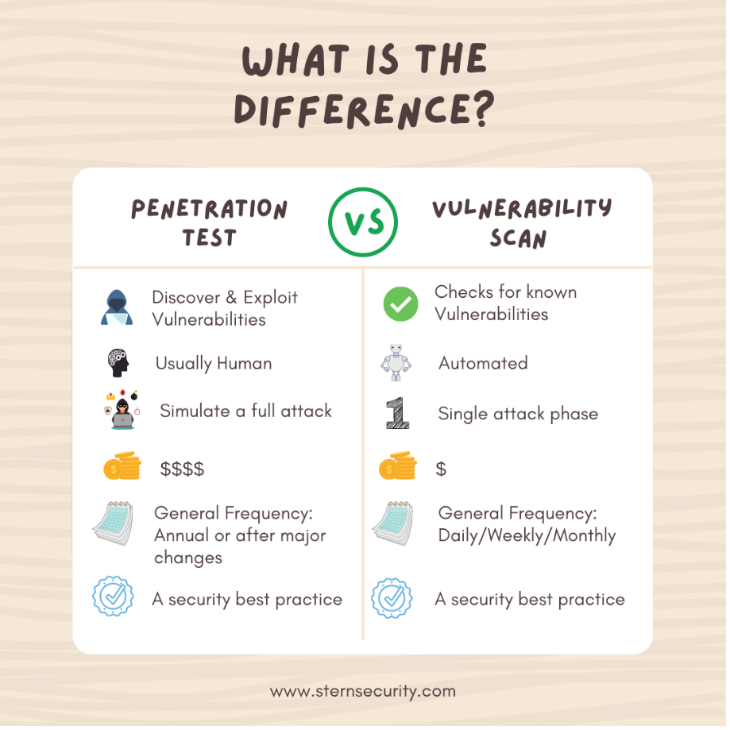
- A vulnerability scan is typically an automated process that identifies known weaknesses in systems, applications, and network devices. Scanning tools compare the systems against databases of known vulnerabilities and produce reports highlighting potential problems such as missing patches, outdated software, or common misconfigurations. Because this process is mostly automated, vulnerability scans are relatively low-cost and can be run frequently. They are a crucial part of routine cybersecurity practices, but they do not demonstrate how an attacker might actually exploit those vulnerabilities.
- The penetration test goes much further. A true penetration test mimics the techniques used by real attackers. Skilled security professionals manually analyze systems, verify vulnerabilities, and attempt to exploit them to determine how far an attacker could move within an environment. Instead of just listing vulnerabilities, a penetration test demonstrates the real-world impact by revealing whether weaknesses can be combined, whether sensitive systems can be accessed, and whether existing controls can detect or stop an attack.
A penetration test is not about criticizing an organization or making clients uncomfortable. Instead, it’s a collaborative effort in which we work with your team to identify security gaps and improve your defenses together. When approached as a partnership, penetration testing becomes a productive process that builds trust, boosts your security posture, and helps develop your overall cybersecurity program.
Vulnerability Scan vs Penetration Test
Organizations evaluating a penetration testing provider should focus on several key factors to ensure the engagement delivers meaningful results.
Five Questions to Ask Before Hiring a Penetration Testing Firm
1. What will the final report look like?
A thorough penetration test report should include an executive summary, technical findings, proof of exploitation, and clear remediation guidance. Always request a sample report before hiring a firm.
2. What methodology do you follow?
Professional testers should adhere to structured and recognized testing frameworks. This guarantees testing remains consistent, repeatable, and aligned with industry standards.
3. How will the testing scope be established?
The scope should clearly specify which systems, applications, or networks will be tested, along with the techniques to be used. A well-defined scope protects business operations and ensures testing addresses significant risks.
4. Who will conduct the testing, and what experience do they have?
Penetration testing demands highly skilled professionals. Organizations should verify the qualifications and experience of testers performing the work and, when appropriate, request references.
5. How will communication happen during the engagement?
Effective penetration testing relies on:
- Collaboration
- A dependable testing partner to provide regular updates
- Answers questions from internal teams
- And clearly explains findings so organizations can learn from the results
Organizations should also understand the limitations of automated penetration testing tools. Security automation has advanced significantly, enabling these tools to identify common vulnerabilities across large environments quickly. However, automated tools cannot fully imitate the creative thinking of skilled attackers.
Automated tools often struggle to:
- Combine vulnerabilities
- Detect business logic flaws, or bypass layered security controls
- Therefore, automated testing works best when used alongside manual penetration testing instead of replacing it.
A well-conducted penetration test should do more than just list vulnerabilities.
It should demonstrate how weaknesses can be exploited, identify gaps in current controls, and offer a clear plan to improve security.
At Stern Security, our penetration testing services are designed to identify real-world attack paths and strengthen organizations’ cybersecurity defenses. Our experienced team combines automated tools with human analysis to demonstrate how attackers could exploit systems and how these risks can be mitigated.